From Junior to Staff Engineer: Scaling beyond a single team
Many Backend Engineers reach a crossroads at some point in their career when thinking about future progression. Some specialise further, some go down the people management route, and others follow the technical leadership track. While equally valued, the three paths carry different kinds of responsibility and impact. Finding the right one for you can make all the difference.
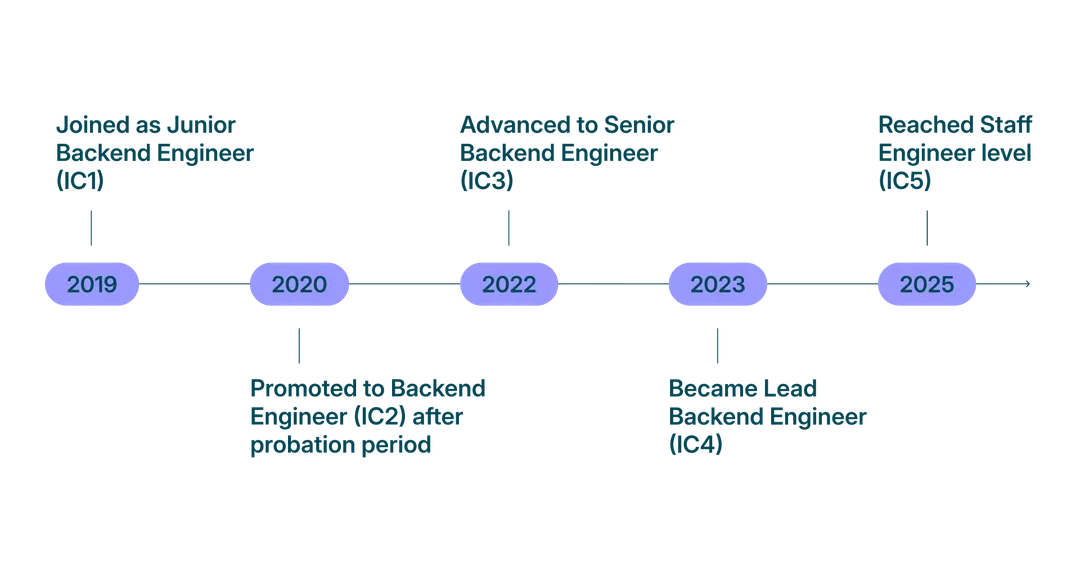
That’s exactly what Paulina Overaitė, Staff Engineer, Trust & Safety, did after joining us in 2019. In just 6 years of working here, she progressed from Junior Backend Engineer to a technical leadership role. We sat down with her to find out more about her journey: from finding her feet to winning awards – sometimes as the only woman in the room.
Paulina's career timeline at Vinted
The day-to-day life of a Staff Engineer
A self-described mix of the Architect and Right Hand staff engineer archetypes, Paulina’s daily work involves designing scalable system architecture, mentoring other engineers, helping teams untangle complex technical challenges, and setting the Trust & Safety domain’s technology vision to ensure our platforms are future-proof.
To put it simply, think of a sports team. If the Director of Engineering is the General Manager, who is responsible for building the team and setting the overall strategy, the Staff Engineer is more like the Head Coach. They focus on the playbook, technical design, and how everyone actually plays together, working alongside the Lead Engineer, who is like the team captain.
Some weeks are heavily focused on deep-dive technical design, while others are almost entirely dominated by organisational alignment. Paulina’s impact comes less from writing code herself and more from empowering others – stepping in only when technical guidance is needed. What matters most is that our teams are set up for success and pulling in the same direction.
Another important focus is balancing rapid delivery with long-term architectural integrity. While AI coding assistants have accelerated software development, reviewing code for quality, maintainability, and architectural alignment remains a deeply human, cognitively demanding task. Tied to this is the challenge of finding the right level of involvement. As a Staff Engineer, you are a technical authority, but you must avoid micromanaging every decision, or you’ll create a bottleneck and stifle team growth. The real art is learning how to step back and trust teams to make their own choices, while having the intuition to know exactly when to step in and guide them on critical issues.
Career growth through experimentation
Paulina’s career progression at Vinted hasn’t always been linear. She has experimented with different roles and projects, guided by the realisation that the real "north star" of a career isn’t gained by climbing the career ladder, but by finding the best fit for where you are in life.
She explored the people management pathway when she was a Backend Engineer, and became an Engineering Manager for our Engineering Academy participants. But it was while she was covering for a Staff Engineer during their holiday that she realised the technical leadership pathway was a better fit for her skills, passions, and long-term aspirations:
I realised that my energy comes from solving complex technical and architectural puzzles and scaling my impact as an individual contributor, rather than focusing on day-to-day people management.Paulina Overaitė, Staff Engineer

Some Backend Engineers at Vinted choose to go down a specialist path and work on highly-specific, technical challenges. Others, like Paulina, decide to focus on a more holistic view of how our different systems and platforms intertwine – working across teams to solve company-wide problems. Becoming a Staff Engineer wasn’t a dramatic turning point, but a natural progression for someone who felt drawn to engineering projects that lived outside her team’s scope.
"I wanted to solve systemic issues – things that technically weren't my "direct responsibility" but still caused friction and pain points for us at the end of the day."
The biggest shift for Paulina came from the transition from Lead Backend Engineer to Staff Engineer, when all of a sudden, she didn't have a single home team anymore. This meant losing the familiar structure of daily standups, sprint planning, and the typical agile or scrum ceremonies. Without the immediate dopamine hit of closing Jira tasks or shipping features, it can be harder to recognise your immediate impact. Day-to-day coding gets delegated, and other engineers lead specific projects. Paulina discovered that her new role was about multiplying impact through others rather than driving the execution herself.
Tips for career progression
Having gone from Junior Backend Engineer to Staff Engineer in just 6 years, we asked Paulina if she worked on any skills or formed any habits that helped her progress to senior levels. For her, it’s all about "proactive ownership" of both your own career and your team’s success. In practice, this came down to four "rules" she started following early on:
1. Be strategic and proactive with your growth. Don't wait until the end of the quarter to think about your impact. Focus on tasks that align with the path you want to pursue – not just when it's time to write your self-evaluation.
2. Your team’s success is your success. Don’t chase individual projects at the cost of your team. If your team fails, any individual "star" work doesn't matter. Real seniority is about making sure the whole ship succeeds.
3. Keep a record of your work. Not everyone will remember every smart design decision, helpful comment, or project milestone you achieved. Keep a running list of your accomplishments and invest real effort into branding yourself during quarterly and yearly reviews.
4. Apply common sense over checklists. Look at what your team actually needs right now and tackle those blockers – whether that means calling out a risky timeline, sharing feedback, or raising your hand to ask for help when a task is slipping.
This mentality has also helped Paulina approach promotions. Rather than aggressive negotiations, which don’t come naturally to her, she broaches the topic through transparency – while always aligning her expectations with organisational restraints and business realities.
Be open with your manager from the start. Tell them you want to grow, and share your personal growth plan with them early on. Make sure your strategy aligns with what your manager and the business actually expect from you.Paulina Overaitė, Staff Engineer
Diversity as an organisational superpower
In 2023, Paulina was a mentor for Women Go Tech. In 2024, she won Build Stuff’s prestigious "Woman in Software" award for her visionary leadership at Vinted while enhancing the Trust & Safety domain. Winning the award helped Paulina feel seen and appreciated. Since then, she has made a point of giving others the same kind of genuine, positive recognition to help them move forward.
We all carry a mix of what society considers "masculine" and "feminine" qualities. Early in her career, Paulina was often the only woman in the room. At times, she felt like only the more “masculine” parts of her identity were worth sharing, while believing the more “feminine” parts should be kept hidden – glossing over her dance classes and instead bringing up her weekend of snowboarding, for example. Part of this hesitation came from the awareness that, in some working environments, women’s soft skills can be dismissed as “too emotional”, while men displaying the same qualities are more likely to get praised for their emotional intelligence. Joining Vinted gave Paulina the opportunity to do things differently. Challenging the status quo and showing up as your authentic self can be scary, but this authenticity often encourages others around you to do the same. Paulina believes this mindset has been a key part of her success.
With AI increasingly handling raw coding tasks, working in tech is no longer just about writing code. The most complex challenges are human and organisational: team structures, communication bottlenecks, and balancing cost versus effectiveness. It requires a mixture of skills that go far beyond just being good at maths or writing syntax. Paulina remembers working with an Agile Coach who had a degree in psychology. Her ability to look at our teams from an outsider's perspective, diagnose communication breakdowns, and figure out why a team was struggling was incredibly impactful.
Having career switchers or people with non-traditional backgrounds in the room is a huge superpower for engineering organisations. After all, sometimes it’s incredibly difficult to debug what’s not working when the bug isn't in the code!
Want to be part of Vinted’s long-term technical direction?
Technical leadership at Vinted is grounded in clarity, care, and ambition done right. If you’re ready to align high-level technical vision with business strategy, we could be just the place for you.
Explore open Staff Engineer roles at Vinted.